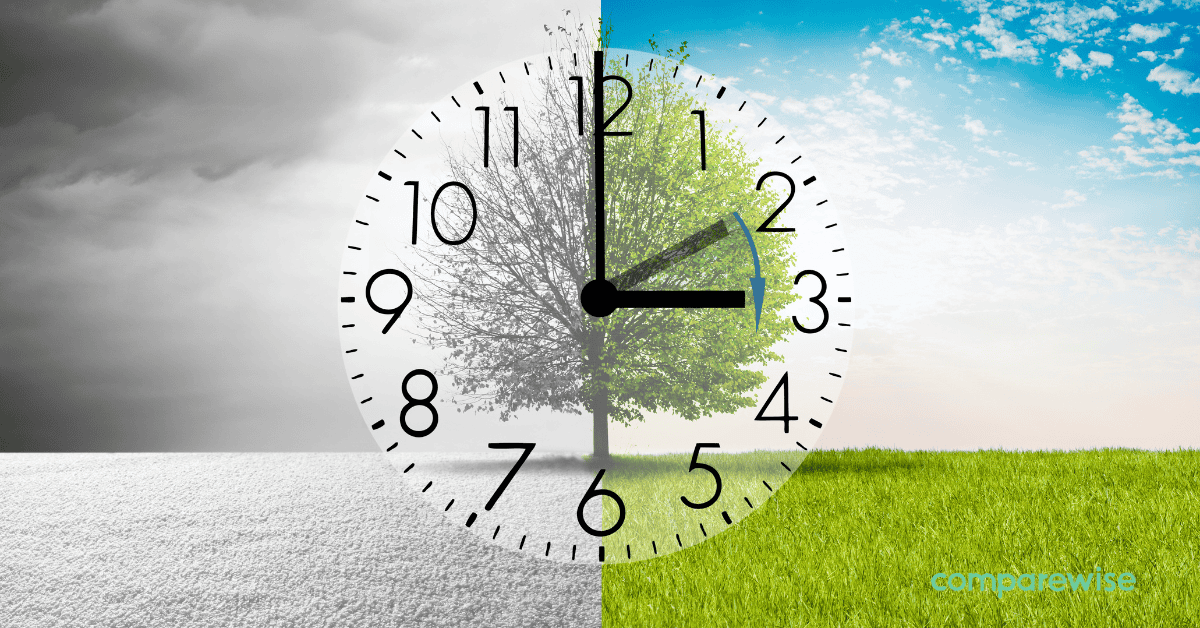
Time changes can be confusing when you’re trying to remember whether you should spring forward or fall back.
Millions of Canadians change their clocks twice a year, but they still remain confused about the details. So, in this daylight savings time guide, we will go through all you need to know about the Canadian time change currently.
Whether you’re in Ontario, BC, or anywhere else across the country, we’ve got you covered with exact dates, helpful tips, and answers to your most pressing questions about when the clocks change.
Daylight saving time is a tradition at that time of the year, when we adjust our clocks forward by one hour during warmer months to make better use of natural daylight.
The concept is that, by shifting an hour of daylight from morning to evening, we can enjoy longer daylight hours when most people are awake and active.
Canada first adopted daylight saving time during World War I in 1916 to conserve energy. But the practice stuck around, though it has changed over the years.
Today, most Canadian provinces observe this ritual twice a year, making it an important part of Canada’s national routine.
It is on the basis of a spring forward, fall back principle. Come spring and we take the clocks forward an hour (losing an hour of sleep and gaining an hour of evening light).
In fall, we set our clocks back one hour, gaining that hour of sleep back but losing evening daylight as we head into winter.
You might notice people say both “daylight saving time” and “daylight savings time.”
Technically, the correct term is “daylight saving time” (no ‘s’), but both versions are widely understood and accepted across Canada. We use both terms in this daylight savings time guide since that’s how most Canadians search for information online.
The important thing to remember is that daylight saving time affects your daily schedule twice a year.
Your smartphone and computer likely adjust automatically, but wall clocks, car clocks, and other manual timepieces need your attention during each transition.
Planning ahead for daylight saving time 2025 will help you stay organized and avoid the confusion that comes with time changes.
Canada follows the same daylight saving schedule as the United States, with two key dates to remember throughout the year. These dates are set well in advance, so you can mark your calendar now and prepare for both the spring and fall transitions.
If you’re asking when is spring forward 2025? Spring forward 2025 happens on Sunday, March 9th at 2:00 AM. At exactly 2:00 AM, clocks jump directly to 3:00 AM, meaning that hour from 2:00 to 3:00 AM simply doesn’t exist on that day.
This switch into springtime represents the arrival of daylight saving time throughout most parts of Canada. Whether you’re in Toronto, Vancouver, or Halifax, the change happens at the same moment relative to your local time zone.
If you’re asking When does daylight saving time end in 2025? Fall back 2025 occurs on Sunday, November 2nd at 2:00 AM. At 2:00 AM, clocks turn back to 1:00 AM, giving you an extra hour in your day.
This fall back time change marks the end of daylight saving time and the return to standard time for the winter months. This date applies to all Canadian provinces that observe the time change.
Most Canadian provinces follow the same general schedule, but there are some important exceptions that can catch you off guard if you’re not prepared. Understanding how each province handles time changes helps you stay coordinated.
Time change Ontario follows the standard North American schedule for 2025. Ontario springs forward on March 9th and falls back on November 2nd in 2025.
The province has maintained consistent daylight saving time observance since the 1970s, making it a reliable part of the seasonal routine for over 14 million Ontario residents.
Quebec also matches perfectly with Ontario daylight savings schedule, as well as, Maritime Provinces. The three Canadian provinces with daylight saving time are New Brunswick, Nova Scotia and Prince Edward Island, all sharing the same dates.
This synchronization in eastern Canada makes business operations, as well as activities among family members across the borders, very easy.
The one major exception in central Canada is Saskatchewan, where most of the province doesn’t observe daylight saving time at all. Saskatchewan stays on Central Standard Time year-round, which creates an interesting time relationship with neighbouring provinces.
During summer months, Saskatchewan effectively operates on the same time as Alberta, and during winter months, it aligns with Manitoba’s time zone.
BC daylight savings operates on Pacific Time, changing on March 9th and November 2nd in 2025, the same dates as Ontario, but occurring three hours earlier due to the time zone difference.
British Columbia continues to deliberate on the abolishment of changing daylight savings time but the province keeps the conventional spring forward and fall back time for 2025.
Alberta follows the Mountain Time zone schedule, observing daylight saving time changes on the same dates as other Canadian provinces.
The province has conducted public consultations about potentially eliminating time changes, but maintains the current system for 2025. Manitoba also observes standard daylight saving time transitions on the established dates.
The case of Saskatchewan is the most unique one in patterns of time change in Canada 2025. Most of the province experiences Central Standard Time throughout the year, and the whole changing the clock twice a year has been done away with.
This system abolishes the ambiguity of time adjustments, and demands that Saskatchewanians keep in check the difference in time with provinces that do follow daylight saving time.
Yukon Territory made a permanent switch to Pacific Daylight Time in 2020, effectively staying on the same time as Vancouver year-round. This means Yukon doesn’t change clocks anymore, joining Saskatchewan as a Canadian jurisdiction that has eliminated time changes.
Some Indigenous communities across Canada may choose not to observe daylight saving time, and certain remote communities might operate on schedules that don’t align with standard time changes.
However, all major Canadian cities and most towns follow the established daylight saving time schedule.
Modern technology has made changing clocks for daylight savings simpler than ever. Most smartphones, computers, and internet-connected devices automatically adjust for time changes.
However, you’ll still need to manually change the clocks for daylight saving on wall clocks, car clocks, microwaves, ovens, and other non-connected devices.
If you’re wondering what time does the time change? It is always 2:00 AM local time. This timing was chosen because it’s when the fewest people are awake and active, so it minimizes disruption to daily activities and transportation.
For spring forward, set your clocks ahead one hour before you go to bed on Saturday night. For fall back, you can either set them back before bed or enjoy the extra hour and change them when you wake up on Sunday morning.
You might also want to change your smoke detector batteries when you change your clocks. This creates a simple routine that helps ensure your safety devices stay functional year-round. Many fire departments recommend this practice as an easy way to remember battery changes.
The most important clocks daylight savings to remember are those that don’t update automatically: your car, wall clocks, watches, appliances, and any older electronic devices. Make a checklist of these items to ensure you don’t miss any.
Here’s everything you need to know about the Canada time change 2025 dates and what to expect for daylight savings 2025 across the country:
Changing our clocks twice a year affects more than just the time on your wall.
Research from the University of British Columbia shows that the Monday following a spring time change sees a 6% increase in fatal car accidents, largely attributed to sleep disruption and reduced alertness.
Health impacts include disrupted sleep patterns, increased rates of heart attacks, and temporary decreases in cognitive performance.
The Canadian Sleep Society notes that it can take up to a week for your circadian rhythm to fully adjust to each daylight saving time change.
Economically, daylight saving time has mixed effects. Retail businesses often see increased sales during longer evening daylight hours, but the energy savings originally intended by the practice are now minimal.
Modern lighting and air conditioning systems mean that the energy equation has changed significantly since daylight saving time was first implemented.
Canadian agriculture largely operates independently of daylight saving time, as farm schedules depend more on sunrise and sunset than clock time.
However, transportation and supply chain coordination can be affected when agricultural operations need to interface with businesses that do not observe time changes.
The Quebec government estimated that eliminating daylight saving time could save the province approximately $3.4 million annually in productivity losses and health care costs related to time change disruptions.
Preparing for daylight saving transitions can minimize their impact on your routine. Start adjusting your sleep schedule gradually in the days leading up to each change.
Go to bed 15 minutes earlier each night for several days before spring forward, and 15 minutes later before fall back.
Light exposure plays a role in helping your body adjust. After spring forward, expose yourself to bright light in the morning to help reset your circadian rhythm.
After fall back, try to get sunlight exposure in the late afternoon to maintain your energy levels as daylight hours shorten.
Avoid caffeine and alcohol close to bedtime during the week of each time change, as these substances can further disrupt already sensitive sleep patterns.
Canadian health experts recommend maintaining regular meal times to help your body maintain its natural rhythms.
Technology can help with the transition. Set your devices to gradually adjust lighting and alarm times if they have these features.
Many Canadians find that smart home systems can ease the transition by slowly adjusting indoor lighting to match the new schedule.
Adjust your work schedule when planning for time changes. If possible, avoid scheduling important meetings or making critical decisions on the Monday following a time change, when alertness may be reduced.
The daylight savings pattern in Canada is the same as in the US, and therefore, this makes the coordination of cross-border trade and travel convenient.
Daylight saving time is not observed in all countries, though. Russia relinquished the practice in 2014, and China never practiced it, even though it crosses many time zones.
European Union countries have a different daylight saving time than that followed in North America, and countries in the European Union change the time at the end of March and the end of October on the last Sunday.
This establishes time intervals in the year when the time difference between Canadian and European cities will be an hour different than that which occurs normally.

Approximately 70 countries worldwide observe some form of daylight saving time, but many have abandoned the practice in recent years. Argentina, Russia, and most of Asia never change their clocks, while Australia observes daylight saving time only in some states.
Canada’s approach to daylight savings for canada reflects her close economic and social ties with the United States. Maintaining synchronized time changes facilitates trade, communication, and travel between the two countries, which remain each other’s largest trading partners.

Several Canadian provinces have passed legislation to eliminate time changes, but most of these laws require coordination with neighbouring jurisdictions before taking effect.
British Columbia passed legislation in 2019 to stay on daylight time year-round, but only if Washington, Oregon, and California make the same change.
Ontario has also passed legislation to end time changes, but it requires coordination with Quebec and New York State.
Alberta has studied the issue extensively, with public consultations showing mixed opinions among residents about whether to eliminate time changes.
The federal government has jurisdiction over time in territories and can influence provincial decisions, but provinces control their own time zone policies.
This means that changes to daylight saving time in Ontario and other provinces require provincial legislative action.
Recent polling by Research Co. found that 53% of Canadians support eliminating daylight saving time changes, while 31% prefer to keep the current system.
Support for elimination is highest in British Columbia at 63% and lowest in Atlantic Canada at 41%.
Make your money do more.
Offers shown here are from third-party advertisers. We are not an agent, representative, or broker of any advertiser, and we don’t endorse or recommend any particular offer. Information is provided by the advertiser and is shown without any representation or warranty from us as to its accuracy or applicability. Each offer is subject to the advertiser’s review, approval, and terms. We receive compensation from companies whose offers are shown here, and that may impact how and where offers appear (and in what order). We don’t include all products or offers out there, but we hope what you see will give you some great options.
No. Most of Saskatchewan stays on Central Standard Time year-round. Yukon switched to Pacific Daylight Time permanently in 2020, eliminating time changes.
Clocks change at exactly 2:00 AM local time in each time zone. This timing minimizes disruption since fewer people are awake then.
Saskatchewan (most areas) and Yukon don't change clocks. Saskatchewan stays on standard time, while Yukon stays on daylight time year-round.
Several provinces have passed legislation to end time changes, but these laws require coordination with neighbouring regions before taking effect.
Top deals await you just a short
application away!